I Worked For You
Preserving the Culture of Public Service

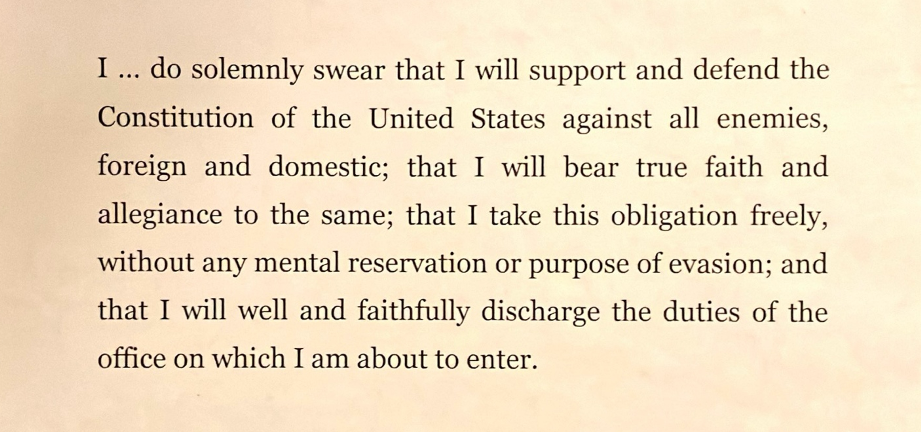
The printed version of my oath of office that I posted on my office wall
I spent most of my career at the State Department in Washington, DC. When I met people around the country and they asked what I did, I would answer “I work for you.” Then I would explain that I worked for the federal government. Of course, I reported to and took marching orders from the elected political leadership, but my highest responsibility was to the American people.
I worked in the Civil Service for over thirty years. Each time I started a new job, I took the oath of office to “support and defend the Constitution of the United States.” Our Constitution begins with the words “We the People,” defining the United States as a republic. As President John Adams said, our republic is “a government of laws, not men.” The oath is a reminder to public servants to obey the law.
In my career, I was privileged to work alongside many accomplished professionals who were dedicated to serving the American people. But even more than a career, public service is a culture. It relies on a body of knowledge that has been built up over generations and adapts its practices and priorities to meet the demands of the time and respond to changes in political direction. The building and transmission of expertise has been a great strength of our system of public service. I learned from my predecessors, and then learned by doing, and then helped the next generation learn to find its own way.
The Trump Administration is working systematically to destroy the culture of public service and to transform our government into one based on loyalty rather than competence. Former career diplomat and CIA Director Bill Burns, in an open letter published in the Atlantic, described it as “a war on public service and expertise.” The government is supposed to be honest and fair, to operate “without fear or favor.” But government based on loyalty to a leader who demands praise and obedience, is neither honest nor fair. It rejects inconvenient facts, punishes dissent, and encourages people to seek advantages not through fair competition but by currying favor with the leader. Loyalty tests lead to cronyism and corruption. They make our government less efficient, less effective, less fair, and less trustworthy; they weaken our country and leave our people less secure and less prosperous.
There is no better illustration of the conflict between loyalty and the rule of law than the dispute between Acting U.S. Attorney Danielle Sassoon and Acting Deputy Attorney General Emil Bove in February, 2025. Bove ordered Sassoon to seek dismissal of corruption charges against New York City mayor Eric Adams, but to maintain the threat of prosecution as a way to pressure Adams to do the Administration’s bidding. Sassoon refused, citing the strong evidence valid grand jury indictment against Adams and a Supreme Court decision that the Constitution prohibits politically motivated prosecutions and, by extension, use of threatened prosecution for political coercion. Bove responded by dismissing this legal prohibition as a policy judgment, saying “Your oath to uphold the Constitution does not permit you to substitute your policy judgment for that of the President or senior leadership of the Justice Department.”
The Trump Administration has taken many actions to undermine the culture of public service. In addition to the arbitrary and illegal mass firings of federal workers, the Trump Administration has systematically worked to undermine the professional Civil Service by moving many of the most experienced officials into new job categories where they could be fired at will and by making loyalty to the President a key factor in hiring and promotions. This could lead to a return of the corrupt “spoils system” under which Presidents rewarded their political supporters with federal jobs. Putting fidelity to leadership above qualifications and fealty to the law opens the door to widespread corruption and incompetence. The Administration has run roughshod over conflict of interest rules designed to ensure that officials act to serve the public interest and not to the private interests of the President, his political appointees, and his supporters.
Soon after President Trump took office in 2017, his actions raised questions about his commitment to uphold his oath of office to “preserve, protect, and defend the Constitution of the United States.” I printed a copy of my own oath of office and posted it on my office wall as a reminder that my first loyalty was to the law. The American people deserve no less.
Unfortunately, the ongoing assault on public service continues to harm not only federal workers but the public at large. In this new year, I urge my fellow citizens to join in expressing our support for the values and culture of public service, our gratitude for those who have served and continue to serve in such difficult times, and our commitment to rebuild a government “of the people, for the people, and by the people.”
Mark Goodman is a senior scientist who retired from the State Department in 2025 after a thirty-year civil service career. He has worked extensively on international nuclear policy, including nuclear energy, nonproliferation, arms control and disarmament. Dr. Goodman is a non-resident fellow at the Center for Nonproliferation Studies, a Fellow of the American Physical Society, and a member of The Steady State.
Well said. Our civil service culture took generations to build. It sustained a crippling blow in 2025, and its rebuilding—not yet even on the horizon—is by no means guaranteed. Unfortunately, I fear the majority of our fellow American citizens have no concept of its value, or what in means to live in a society that doesn’t benefit from a professional and ethical civil service. Thanks to Mark G. for trying to convey it.