A Climate of Isolation
We Can’t Insulate Ourselves from Global Climate Change

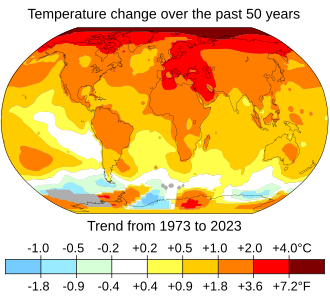
The Trump Administration has worked systematically to discredit the scientific consensus on climate change and to dismantle efforts to limit and cope with the damaging effects on the planet. On January 7, President Trump announced that the United States would withdraw from 66 international organizations and agreements, claiming that “many of these bodies promote radical climate policies.” That list includes two at the core of international climate science and policy, the Intergovernmental Panel on Climate Change (IPCC) and the UN Framework Convention on Climate Change (UNFCCC).
These withdrawals will do damage at home and abroad. They harm the planet by undermining international efforts to understand, limit, and cope with climate change. They leave the United States politically marginalized and less able to cope with the dangerous and accelerating effects of climate change. The United States can isolate itself politically, but it cannot insulate itself physically. Climate change knows no boundaries and will drive conflict and migration around the world.
Scientists have known since the late 19th century that carbon dioxide released in the burning of fossil fuels could cause the Earth’s climate to warm, but the problem came into focus in the 1980s. The Intergovernmental Panel on Climate Change (IPCC) was established in 1988 and has become the leading international body for assessments of (1) the physical science basis for understanding how climate is changing and what is driving that change, (2) the environmental and human impacts of climate change and ways to adapt to those effects, and (3) actions we can take to limit and mitigate the extent of climate change.
The IPCC has published a series of reports addressing these three aspects of the climate problem. These reports have grown more definitive as our understanding has improved and as the effects of a warming climate have become undeniable. The second IPCC assessment in 1995 found a “discernible human influence on global climate,” supporting the idea of concerted action to mitigate that influence. The sixth assessment in 2021 concluded more starkly “It is unequivocal that human influence has warmed the atmosphere, ocean and land. Widespread and rapid changes in the atmosphere, ocean, cryosphere and biosphere have occurred.”
Withdrawing from the IPCC will deprive it of official U.S. support for the next seventh assessment, which is now underway. It will not stop U.S. scientists from taking part in that assessment through their affiliations with observer organizations like the American Geophysical Union and the US Academic Alliance for the IPCC. But U.S. withdrawal will eliminate support from U.S. agencies and laboratories, and cuts in research funding will hamper the participation of academic scientists. This will leave gaps that scientists from other countries will have to fill.
But the main purpose of the withdrawal is to move the United States away from the fact-based discourse on climate to one based on ideology and deception. President Trump told the United Nations in September that climate change is a “hoax” and a “con job,” a lie he has been telling the American people for years. He would like to silence the voices of the truth tellers, but, as President John Adams said, “facts are stubborn things.” Climate denial does not alter the facts, which are increasingly evident.
The UN Framework Convention on Climate Change (UNFCCC) is a 1992 international treaty that provides a framework for concerted international efforts to mitigate and adapt to climate change. It was signed and ratified in the George H.W. Bush Administration and supported by every subsequent administration until the current one.
The UNFCCC was adopted at a time when the problem of climate change was becoming clear but the path for dealing with it was not. Its objective is stated in general terms: “to prevent dangerous anthropogenic interference with the climate system.” Its requirements are similarly general: national reporting on emission of carbon dioxide and other greenhouse gases that are driving climate change, implementing (unspecified) programs to mitigate climate change, cooperating on measures to adapt to the effects of climate change, and cooperating on climate science.
As a framework, the UNFCCC does not mandate specific targets or actions to limit greenhouse gas emissions. It left those for subsequent agreements, notably the 1997 Kyoto Protocol, which the United States did not join, and the 2015 Paris Agreement. The Paris Agreement sets a goal of limiting overall warming to 2 °C (4.4 °F) but allows each country to determine how it will reduce greenhouse gas emissions to contribute to that goal. Current national commitments fall short of what is needed to meet this goal, and many countries are falling behind on meeting those commitments. The last three years have been the three warmest on record, with temperatures in 2024 (the warmest) exceeding 1.5 °C.
More needs to be done, but the Trump Administration has chosen instead to withdraw, to deny the problem and give up on trying to solve it. Every country in the world has joined the UNFCCC and almost all have joined the Paris Agreement. U.S. withdrawal leaves us completely isolated. And President Trump has chosen not just to opt out but to reverse course. The Administration is attacking the most promising avenues for progress: the rapidly falling prices of renewable energy and the adoption of electric vehicles. In July, the Environmental Protection Agency proposed to rescind its 2009 finding that greenhouse gas emissions endangered the global climate, a finding that provides the basis for domestic regulation of greenhouse gas emissions. The President’s misguided policies have reversed years of decline in the burning of coal which, in addition to its damaging health effects, is by far the worst greenhouse gas emitter.
But this is not a mere policy disagreement about how to advance U.S. national interests. It is an attack on those interests. These otherwise inexplicable reversals appear to be motivated by a desire to diminish and exact retribution on President Trump’s predecessors and political opponents. They are an attack on the very idea of our republic: that the government of the people should act in the interest of the people.
They will make America less safe and more vulnerable to environmental disasters, international conflict, and migration.
They will make Americans less healthy and more vulnerable to air pollution and heat-related diseases.
They will make America less prosperous, as China and others take the lead on the clean energy technologies of the future.
And they diminish America, which helped build the international system it is now abandoning and attacking.
Mark Goodman is a senior scientist who retired from the State Department in 2025 after a thirty-year Civil Service career. He has worked extensively on international nuclear policy, including nuclear energy, nonproliferation, arms control and disarmament. Dr. Goodman is a non-resident fellow at the Center for Nonproliferation Studies, a Fellow of the American Physical Society, and a member of The Steady State.
Thank you, Mark, for this well-researched, frightening summary. To me, this is the essence and what must be shared broadly:
… “The United States can isolate itself politically, but it cannot insulate itself physically. Climate change knows no boundaries and will drive conflict and migration around the world.”